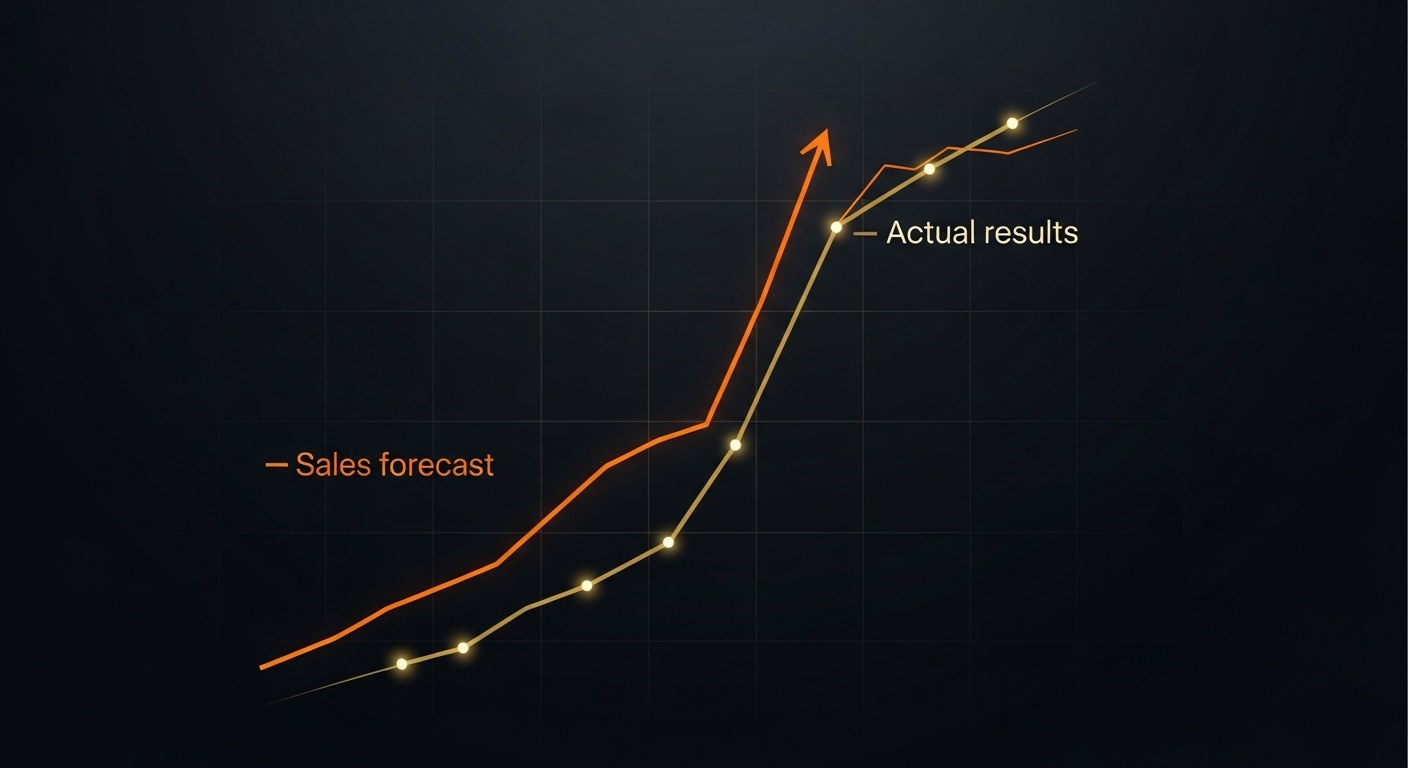
How accurate should your sales forecast be? Run this 10-minute test.
How accurate should your sales forecast be? Run this 10-minute test.
A week-one forecast that lands within 5% of actual close is a well-run engine. Within 10% is workable. A miss beyond 20% that nobody can explain afterward is not a forecasting problem, it's an instrumentation problem. The number most teams quote is the wrong one, because it's measured at the wrong moment.
Here's the test, and what to do about whatever it tells you.
Why week one is the only honest forecast
By week eleven of a quarter, everyone is accurate. Deals have closed or they haven't, the commit has been revised three times, and the forecast has quietly converged on reality. Grading that number tells you nothing, because it isn't a prediction anymore. It's a description.
The week-one forecast is the only one that had to be a real claim about the future. It's also the only one you made resourcing decisions against: the hire you approved, the spend you committed, the number you gave the board.
So that's the one to grade.
The test
Ten minutes, and finance already has the inputs.
1. Pull the forecast as it stood in the first week of last quarter. Not the revised one. The original.
2. Pull what you actually closed that quarter.
3. Calculate: `|forecast − actual| ÷ actual × 100`
4. Now the part that matters more than the arithmetic. Write down, from memory, why the gap exists. Name the deals.
Step four is the real diagnostic. If you can name the three deals that caused the variance, you have a forecasting process with a bad quarter. If the honest answer is "sales got optimistic," you don't have a forecasting process. You have a ritual.
What your number means
This is the scale I grade on when I assess a revenue engine. It isn't an industry benchmark, it's the band structure I use, and it's deliberately harsher than most.
- Within 5%, variance traceable to named deals: The forecast is an asset. You can hire against it.
- Within 10%: Workable. Good enough to plan with, not yet good enough to defend.
- 10–20% off: The forecast has stopped being useful for planning, and people have quietly started routing around it.
- 20%+ off, unexplained: You are not forecasting. You are estimating, and calling it a forecast in the board deck.
One caveat worth being honest about: a single quarter is an anecdote. Run it across four and look at whether the misses share a direction. Consistent overestimation is a process problem and it's fixable. Random scatter in both directions is a data problem, and it's underneath the forecast rather than inside it.
Why forecasts miss, structurally
Nearly every chronic forecast miss traces to one of three causes, and only one of them is about forecasting.
The pipeline is too generous. Deals sit in late stages that no one can name a next step for. The forecast is arithmetic performed on fiction, and the arithmetic isn't the broken part.
Stage changes cost nothing. If a rep can advance a deal by changing a dropdown, the stage carries no information, and stage-weighted forecasting inherits that emptiness.
Nobody owns accuracy. Quota has an owner. Pipeline has an owner. Forecast accuracy is usually everyone's concern and no one's number, and unowned metrics don't improve.
What to do about it
Three moves, in order. They're deliberately uncomfortable.
Write the number down in week one. Publish the week-one forecast somewhere it can't be quietly revised. You cannot improve an accuracy you never recorded, and most teams have genuinely never recorded it.
Make every miss have a name. Variance gets attributed to specific deals, not to sentiment. "Sales got optimistic" is a mood, and you can't fix a mood. "These four deals slipped because procurement wasn't engaged before the demo" is a cause, and causes have fixes.
Grade the forecaster, not the forecast. Track accuracy by rep and by manager, and review it the way you review quota. Reliability stops being a personality trait and becomes a number someone owns.
The first quarter you do this, your coverage number will look worse. That's not a side effect. Coverage dropping and accuracy rising are the same event.
Where this fits
Forecast integrity is one of four dimensions that determine whether a revenue engine was designed or merely accumulated. The other three are data foundation, pipeline discipline, and AI governance. They're linked: a forecast can only be as good as the pipeline underneath it, and a pipeline can only be as good as the definitions underneath that.
Which means the forecast is often the symptom rather than the disease. Fixing it without checking what's below it is how teams end up doing this exercise twice.
You don't need to give me your email to have used any of this
Everything above works standalone. Run the test on your own numbers, apply the three fixes, and never speak to me. That's a completely legitimate outcome and it's why none of this is behind a form.
Here's the one thing this post can't do for you.
It gave you one of the seven questions I use, and no way to know how the other three dimensions score, which one is capping the rest, or what the gap costs you in a year. That requires your answers, not mine.
Take the Architecture Audit. Seven questions, three minutes, results on screen. No email required to see them.
At the end, there's a field for your email. It buys one specific thing: a one-page version of your result, formatted to forward. Most people who run this can't act on it alone. A CRO needs their CEO. A CEO needs their CFO. And the person who didn't take the assessment is never going to be moved by a description of it over coffee.
That's the trade. The diagnosis is free either way. The email gets you the version you can put in front of the person who controls the budget.
Frequently Asked Questions
What is a good sales forecast accuracy percentage?
A week-one forecast landing within 5% of actual close, with variance traceable to named deals, indicates a well-instrumented revenue engine. Within 10% is workable for planning. Misses beyond 20% that cannot be explained after the fact usually indicate a data or pipeline problem rather than a forecasting one.
When should forecast accuracy be measured?
At week one of the quarter, compared against final actual close. Forecasts measured later in the quarter converge on reality automatically and therefore measure nothing. The week-one number is the one that resourcing decisions were made against.
Why is my sales forecast always wrong in the same direction?
Consistent overestimation almost always points to pipeline hygiene rather than forecasting method. Deals sit in late stages without qualification evidence, and stage-weighted models inherit that optimism. Random variance in both directions more often indicates inconsistent data definitions upstream.
Can forecast accuracy be fixed without changing the CRM?
Partly. Recording the week-one forecast and attributing every miss to named deals requires discipline rather than tooling. Enforcing stage exit criteria so that advancing a deal requires evidence usually does require system configuration.
How long does it take to improve forecast accuracy?
Expect one full quarter to establish a baseline and two more before the trend is readable. Anything faster is usually a definitional change rather than a real improvement in predictive accuracy.
Want All 12 Frameworks?
Get the complete 2026 Revenue Leader's Playbook with consulting-grade issue trees, first principles thinking, and agentic AI deployment templates.
Keep reading
Related articles
Ready to Transform Your Business with AI?
Schedule a free discovery call to discuss your AI strategy
Schedule Free Call