State of AI Governance in B2B SaaS 2026: The Free Maturity Benchmark
State of AI Governance in B2B SaaS 2026: The Free Maturity Benchmark
TL;DR: We surveyed 156 B2B SaaS companies ($1M to $500M ARR) in June 2026 on how they govern autonomous AI in revenue operations. 47% run agentic AI with no documented governance framework at all. Companies with operationalized governance report 3x higher audit-readiness confidence and 2.3x more revenue impact from AI. The full report is free and ungated: the four-tier maturity model, the benchmark data behind it, a 15-question self-assessment, and a 90-day roadmap to move up a tier.
Download the free benchmark (PDF). 16 pages. Read it in 15 minutes. Know your tier by the end.
Why this report exists
The companies winning with agentic AI in 2026 aren't the ones deploying fastest. They're the ones with the strongest governance architecture.
Yet nearly half the market is flying blind: agents making revenue decisions with no audit trail, no decision tiers, and no one accountable when something breaks. This benchmark shows exactly where you stand and what separates the top 6% from everyone else.
The headline numbers
- 47% of B2B SaaS companies running agentic AI have zero documented governance framework.
- 156 companies surveyed, $1M to $500M ARR, median $28M. Fielded June 2026, plus 12 high-performer follow-up interviews.
- Companies with operationalized governance report 3x higher confidence in audit readiness and 2.3x higher revenue impact from their AI investment.
- Audit readiness is the sharpest divide in the dataset. It jumps from 31% to 89% at the Tier 2 to Tier 3 boundary.
The four governance maturity tiers
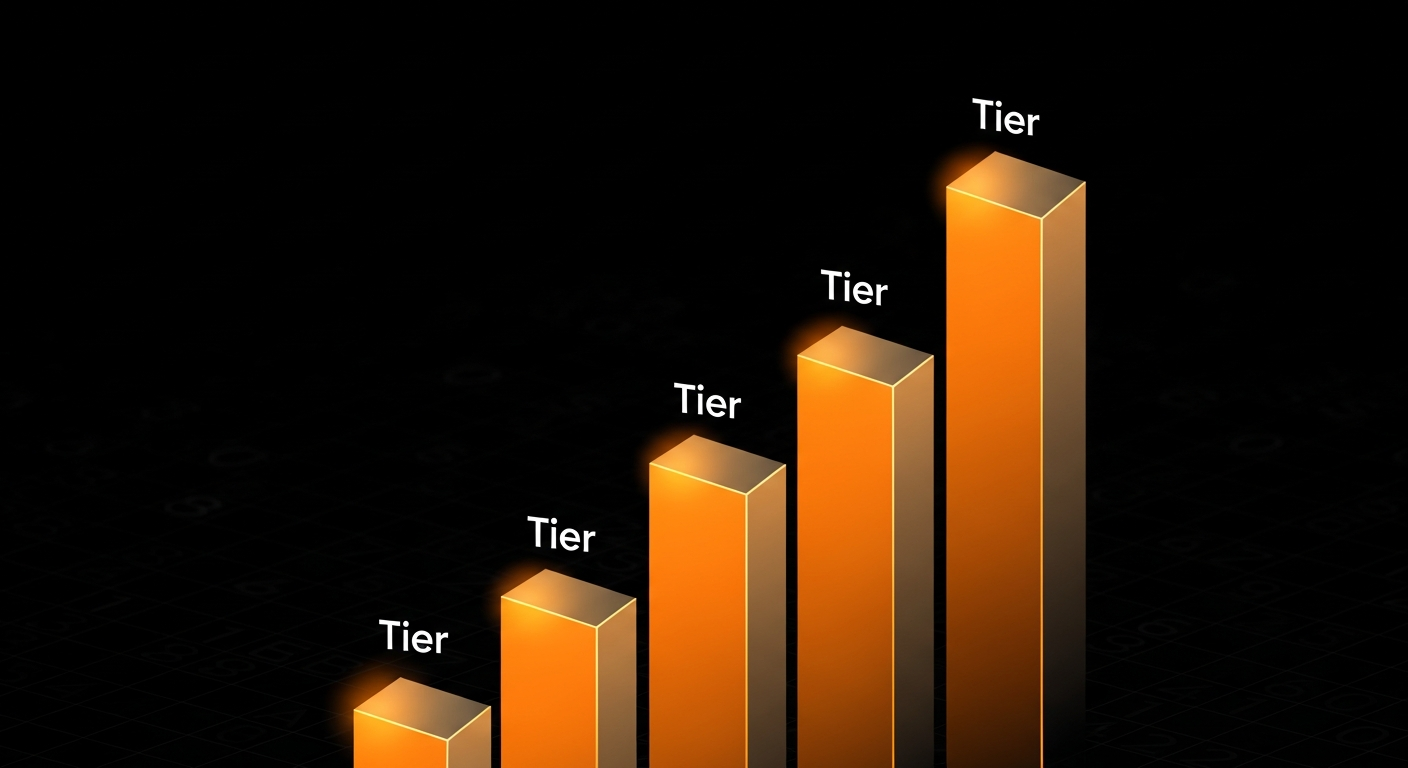
Every surveyed company maps to one of four tiers, defined by how governance is documented, enforced, and embedded.
Tier 1: Ad-Hoc (22% of companies). Agents in production with minimal oversight. Governance means manual spot-checks. Error rates run 15 to 22% and revenue impact from AI is just 0 to 5%. One failure can trigger shutdown of the whole system.
Tier 2: Documented (38%). The framework is written down and basic audit logging exists, but rules aren't enforced by the stack. Error rates of 10 to 16%, revenue impact of 8 to 15%. Defensible in retrospect, painful in an actual audit.
Tier 3: Operationalized (34%). Governance is automated and enforced, mapped to NIST AI RMF, ISO 42001, and the EU AI Act. High-stakes decisions are blocked until a human approves. Error rates of 4 to 8%, revenue impact of 15 to 30%.
Tier 4: Compounding (6%). Governance is embedded in culture, with continuous decision-to-outcome feedback loops. Error rates of 2 to 4%, revenue impact of 25 to 40%. Roughly 8x the return of Tier 1.
The counterintuitive finding: Tier 3+ companies take longer to deploy (12 to 24 weeks versus 6 to 8), but Tier 1 companies redeploy 3 to 4 times because of failures. Slow is smooth, and smooth turns out to be fast.
What's inside the report
- The four maturity tiers with real error-rate, audit-readiness, and revenue-impact ranges.
- Benchmark charts: error-rate trajectories over the first 90 days, time-to-deploy, audit readiness, and 12-month revenue impact by tier.
- The high-performer profile: the five things Tier 3 and 4 companies do differently, each with the action that closes the gap.
- A 15-question self-assessment: score yourself and find your tier in five minutes.
- A 90-day roadmap: a week-by-week path to move up one tier.
- Framework mapping: how NIST AI RMF, ISO 42001, and the EU AI Act apply specifically to revenue operations.
Who it's for: CROs, RevOps and Operations leaders, CFOs, and founders at growth-stage B2B SaaS companies running (or about to run) autonomous AI in the revenue stack.
[Get the report (PDF, free, no gate)](/downloads/sophizo-ai-governance-benchmark-2026.pdf)
The report is yours either way. Here's what the email adds.
This is a living dataset: the next fielding is Q4 2026. Leave your business email and you'll get the updated benchmark numbers and the tier-movement analysis before they're published. One email per quarter, nothing else.
What the top performers do differently
The full report details five behaviors. Two preview highlights:
Executive alignment on AI risk. 94% of Tier 3+ companies have the CEO or CFO explicitly signed off on the AI risk profile, versus just 18% of Tier 1. Governance without executive ownership is a document, not a system.
Clear decision tiers. High performers define which decisions an agent may make autonomously (scoring leads), which require real-time approval (changing the forecast), and which are human-only (strategic pricing). Tier 1 companies have none of this. Everything is "hope it works."
Frequently Asked Questions
What is AI governance maturity?
A measure of how documented, enforced, and embedded your controls over autonomous AI are. It ranges from ad-hoc manual spot-checks at the low end to automated, audit-ready, self-improving governance systems at the high end. The 2026 benchmark maps companies to four tiers: Ad-Hoc, Documented, Operationalized, and Compounding.
How much does poor AI governance cost?
In the 2026 benchmark data, Tier 1 companies see just 2 to 5% revenue impact from AI alongside 15 to 22% error rates. Tier 3 and above see 15 to 40% revenue impact with 2 to 8% error rates. Tier 1 companies also redeploy agents 3 to 4 times due to failures, erasing their apparent speed advantage.
Is the AI governance benchmark report free?
Yes. The report is completely ungated. No email or signup is required to download the PDF. An optional email signup adds you to a quarterly update list for the next edition of the benchmark data.
How many companies were surveyed for the 2026 benchmark?
156 B2B SaaS companies with $1M to $500M in ARR (median $28M), surveyed in June 2026, supplemented by 12 follow-up interviews with high performers. Respondents were CROs and VP Sales (38%), RevOps and Operations leads (34%), CFOs (18%), and CEOs or founders (10%).
What frameworks does the report map to?
NIST AI RMF, ISO 42001, and the EU AI Act, with specific guidance on how each applies to revenue operations. Companies at Tier 3 and above have mapped their governance to at least one of these frameworks.
Where to start
If the 15-question self-assessment puts you at Tier 1 or 2, the fastest first move is the Revenue Architecture Audit: seven questions, three minutes, results on screen. Governance is one of the four dimensions it scores.
If you want the mapping done for you, the Diagnostic Sprint audits your current state against these frameworks and hands you a roadmap in two weeks.
Related reading
This report is part of the Sophizo AI governance series.
Want All 12 Frameworks?
Get the complete 2026 Revenue Leader's Playbook with consulting-grade issue trees, first principles thinking, and agentic AI deployment templates.
Ready to Transform Your Business with AI?
Schedule a free discovery call to discuss your AI strategy
Schedule Free Call